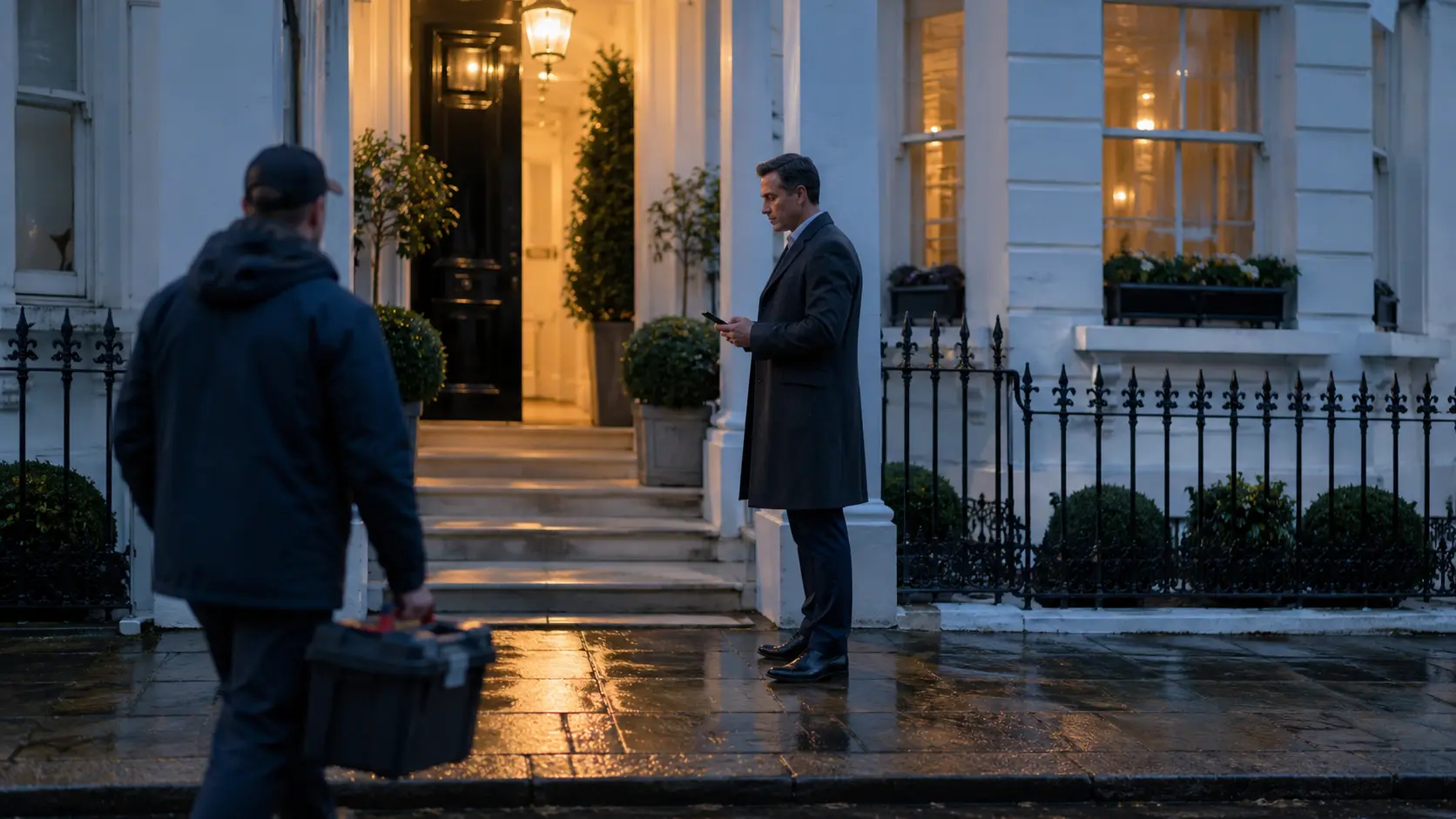
The service should make responsibility clear: who authorises access, confirms changes, records relevant activity and manages cover when the regular professional is unavailable.
Family members, staff, visitors and contractors may arrive throughout the day. The arrangements should fit that activity and preserve the household’s routines.
A proportionate London context
Responsible security advice should be based on facts, not fear.
In July 2026, the Metropolitan Police reported a 14 per cent reduction in neighbourhood offences across London during the 12 months to June. Kensington and Chelsea recorded a 23 per cent reduction over the same period.
That is encouraging. It does not, however, mean every household has the same requirement—or that residential security should be decided by borough-level statistics alone.
The circumstances of the residence remain more important:
- How regularly is the home occupied?
- How many people require access?
- Are contractors, household staff or service providers present?
- Are there periods of travel, renovation or increased visitor activity?
- Who is responsible for confirming changes?
- What should happen when something falls outside the normal routine?
A professional security assessment should establish these facts before recommending personnel, hours or technology.
1. A clear security assessment and written scope
The assessment establishes the coverage required and the responsibilities that remain with the family and household staff.
The assessment should then define:
- the parts of the residence and access points within scope;
- the hours or periods that genuinely require coverage;
- whether the residence is occupied, unoccupied or undergoing renovation;
- who may authorise visitors, deliveries and contractors;
- what the residential security officer may and may not do;
- which events require confirmation, reporting or escalation;
- the format and frequency of reporting;
- relief arrangements and management responsibility.
Sensitive personal or operational information should not be requested before it is necessary. An initial conversation can begin with the broad location, type of residence and nature of the requirement.
Our owner-led assessment process is designed to establish scope before personnel or pricing are proposed.
2. Proportionate access control and visitor management
Access control at a private home is not the same as access control at a commercial building.
An expected guest should be received naturally. An unexpected caller should not be ignored, but neither should they automatically be treated as a threat. Their identity and purpose should be checked through the agreed household contact.
A properly designed visitor management process should clarify:
- who is expected;
- who can approve access;
- how last-minute changes are confirmed;
- where visitors, couriers or contractors may wait;
- what information genuinely needs to be recorded;
- who should be informed if access is declined or delayed.
A security signal should activate a check, not an accusation.
3. Deliveries, contractors and household staff
Property protection often depends on how ordinary transitions are managed.
Deliveries, maintenance visits and contractor access are routine, but each may involve a person who is unfamiliar with the residence. The service should provide a consistent way to confirm who is expected, who authorised the visit and which areas they may access.
This becomes particularly important during renovation, when there may be temporary workers, changing schedules, scaffolding, new keys or access devices, and several contractors operating at the same time.
A temporary change in the residence should trigger a temporary review of the security arrangements—not an improvised or permanent overreaction.
Residential security should also respect the established responsibilities of household staff. The security professional should support the household structure without quietly taking over the roles of a house manager, concierge, receptionist, chauffeur or maintenance coordinator.
4. Appropriate personnel and SIA licensing
For outsourced residential security supplied under a contract for services, individuals undertaking licensable guarding activity must hold the appropriate current SIA licence.
The Security Industry Authority’s current guidance explains that a security guarding licence covers guarding premises or property against matters such as unauthorised access, theft or damage. A close protection licence applies when the role involves guarding people against physical assault or injury.
The actual duties—not the job title—determine which licence is appropriate.
A provider should also have a reliable process for confirming that deployed licences remain valid. The SIA describes how security businesses can use its Licence Status Checker, which draws licence information from the public register.
Licensing is an essential legal baseline. It is not, by itself, proof that an individual is suitable for a private household.
A residential security officer also requires:
- sound judgement;
- calm communication;
- discretion and confidentiality;
- respect for household roles;
- proportionate reporting;
- professional boundaries;
- the ability to remain familiar without becoming informal.
The client should know who selects, briefs and manages the people assigned to the residence.
5. Continuity, relief and handovers
A residential security arrangement that works only when one particular person is present is fragile.
A familiar professional presence is valuable because it reduces repetition and helps the service understand the normal rhythm of the residence. However, continuity must be supported by a managed system.
Relief personnel should receive the information required to perform the role safely and consistently—but no more than they need.
A controlled handover may include:
- expected visitors or contractors;
- temporary access changes;
- unresolved items requiring follow-up;
- relevant household instructions;
- authorised contacts and escalation routes.
The service should remain consistent without requiring the family or household manager to rebuild the briefing every time someone changes.
A useful test is simple: if the usual officer were unavailable tomorrow, would the agreed system still work?
6. Concise reporting and calm escalation
Daily security reporting should provide clarity, not a volume of unnecessary operational detail.
A useful report should answer:
- What relevant activity occurred?
- What required confirmation?
- What action was taken?
- Is any follow-up still required?
- Who was informed, and when?
Reports should distinguish facts from assumptions. Unusual activity can be recorded without presenting an unverified interpretation as a conclusion.
The escalation structure should also be agreed in advance. A routine access question may be referred to a house manager or authorised family representative. A time-sensitive concern may require the secondary contact. An immediate threat to life or safety requires the appropriate emergency response.
7. Privacy and data minimisation
Residential security can involve visitor names, vehicle details, access records, household schedules, incident notes and CCTV footage. More information is not automatically more security.
Where personal data is processed as part of the service, its purpose, access, retention and deletion should be clear.
The Information Commissioner’s Office describes data minimisation as ensuring that personal information is adequate, relevant and limited to what is necessary for its purpose.
In practice, this means asking:
- Why is the information required?
- Who genuinely needs access to it?
- How long should it be retained?
- Where is it stored?
- When and how will it be deleted?
- Under what circumstances may it be shared?
Where CCTV or other surveillance technology is involved, the same principles apply. The ICO’s surveillance guidance emphasises a defined purpose, proportionality, transparency, appropriate security and a justified retention period.
8. Integration with physical and technical security
A security officer should not operate as an isolated layer.
The UK’s National Protective Security Authority identifies behaviour, physical security, the environment around the property and cyber-connected devices as connected parts of home protection.
Depending on the residence, a review may consider:
- gates, doors and locks;
- intercom and access systems;
- alarms and monitoring arrangements;
- CCTV and lighting;
- keys, fobs and temporary access credentials;
- communication routes during an incident;
- smart-home and connected security devices.
A professional presence should work with these measures. It should not be expected to compensate indefinitely for an unreliable gate, an untested alarm, unclear emergency contacts or uncontrolled access credentials.
9. Scheduled review and controlled change
A residential security plan should not remain unchanged while the household evolves.
A review may be required when:
- the family’s occupancy pattern changes;
- new household staff are appointed;
- construction or renovation begins;
- access systems are replaced;
- there is an extended period of travel;
- visitor or contractor activity increases;
- a relevant incident or near miss exposes a gap.
Any change in scope should be authorised, documented and communicated to the people responsible for delivery.
The continuing agreement should define scope, coverage, management responsibility and review.
Choosing the appropriate solution
The correct service depends on where the protection is required.
| Primary requirement | Appropriate starting point |
|---|---|
| Access, visitors, deliveries, contractors and activity around the residence | Residential Security |
| Protection around family movement, school runs, appointments or daily routines beyond the home | Private Family Protection |
Secure Mobility is a supporting capability. Driving, personal protection and any permanent residential post need a defined scope; none should be assumed from a service name alone.
Questions to ask a residential security company
Before appointing a private security company for a London residence, consider asking:
- Who is personally accountable for the service?
- What is included—and explicitly excluded—from the scope?
- Which SIA licence applies to the actual duties?
- How are licences and personnel credentials checked?
- How are security professionals selected for private-home work?
- How will visitors, deliveries and contractors be confirmed?
- What happens when the regular officer is unavailable?
- What information will be recorded, who may see it and how long will it be retained?
- What will the daily or incident report contain?
- How are urgent and non-urgent matters escalated?
- How often will the arrangement be reviewed?
- How are additional duties or changes approved?
Clear answers are more valuable than broad assurances.
The right outcome is quiet
Well-designed residential security should make daily life feel more ordered, not more restricted.
Visitors are received naturally. Contractors are confirmed. Relevant activity is recorded. Unusual circumstances are checked. The right person is informed. Household staff understand the boundaries. Private information remains controlled.
To discuss a residential requirement, begin with only the broad nature and area of the service through our Private Enquiry. Sensitive residential, family or operational details can be considered privately at the appropriate stage.
For further guidance on assessing a provider, read Private Security Services and Client Reviews: What to Look For.
Private. Discreet. Owner-led.